
Showing posts with label Culture. Show all posts
Showing posts with label Culture. Show all posts
Wednesday, 28 April 2010
Culture: Nana Oforiatta Ayim

Tuesday, 29 December 2009
Preserving the cultural heritage of Ghana [Do we have an ‘Acquisition’s of (Heritage) Arts team in Ghana?]….
Feast your eyes on the following art treasures –they hail from Ghana. Wouldn’t it be amazing to own a piece of Ghanaian history –or better still, wouldn’t it be great if these treasures were back in Ghana -where they belong? Can someone tell me if we have an ‘Arts Acquisition’ team in Ghana right now? Do we have a team of people ethically and legally buying back or protecting our [national] treasures – so we can preserve the cultural heritage [ancient art and artifacts] of [this] our great nation? I might need to contact the Director of Ghana National Museum & Monuments……
Object of Desire: Asante Polychrome Sculpture of a Man Holding a Black Ram
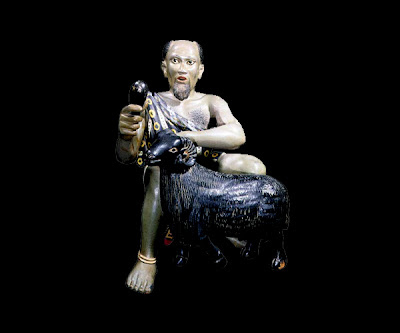
Origin: Southern Ghana
Date: 20th Century AD
POA Website: www.artofancientafrica.com
Object of Desire: Asante Bronze Head

Origin: Southern Ghana
Date: 17 th Century AD to 19 th Century AD
POA Website: www.artofancientafrica.com
I stumbled across the following text –as I was searching for a [possible] Ghanaian Antiquities Arts Acquisition’s team via google… Enjoy it, its an eye opener…..
Title: Ghana's Vanishing Past: Development, Antiquities, and the Destruction of the Archaeological Record By: Benjamin W. Kankpeyeng and Christopher R. DeCorse
Ghana's past is being destroyed at a rapid rate. Although the Ghana Museums and Monuments Board has in some instances successfully intervened to stop the illicit trading of antiquities, the destruction of archaeological sites as a consequence of development over the past two decades has been staggering and the pace is accelerating. The potential of the legislation that established the Ghana Museums and Monuments Board and empowered it to manage and preserve the country's archaeological past has not been realized. The lack of political action, limited relevant public education, insufficient funding, and the poverty of the majority of the Ghanaian populace have allowed for the widespread destruction of both sites and historic buildings. Conspicuously, both the absence of integrated development planning by the Ghanaian government and the inability of development partners (both foreign and domestic) to recognize the potential value of cultural resources have contributed significantly to the continued loss of the archaeological record. While the antiquities trade is a continuing threat to Ghana's cultural resources, it is, in fact, tourism and economic development that pose the major menace to the country's archaeological past. This article reviews the history of cultural resource management in Ghana, including both traditional attitudes toward preservation and current legislation. Case studies are used to illustrate the problems faced. [Credit: http://www.springerlink.com]
Contact: crdecors@maxwell.syr.edu
“Many museum directors, art dealers and auction houses in the West seem to have nothing but contempt and disdain for rules and regulations, especially international rules, intended to control illicit traffic in artefacts which they perceive as attempts to limit their right to acquire artefacts by any means. No wonder that in the last few years that many have been involved in scandals and criminal cases which do not reflect on their standing. Still there are museum directors and others who have more sympathy for looters than for legislators who seek to control the illicit market.
All who have studied the problem of looting of African artefacts have concluded that unless the West limits its demand for African artefacts, there is no way this traffic can be controlled. They add however that there is a lot that the African States themselves could also do if they are seriously concerned by the systematic depletion of their cultural heritage.
The looting of African cultural artefacts for the West which reached its levels of climax in the invasion of Magdala, Ethiopia (1868), Kumasi, Ghana (1874), and Benin, Nigeria (1879) still continues in our time, albeit with different methods and persons but with devastating effects on the cultural heritage of the African countries.” Dr Kwame Opoku [Credit:http://www.modernghana.com]
** What are we going to do about this folks? I know many of you will state the obvious -lack of funding etc -but could it be that we [or the powers that be] haven't fully comprehended the true value of these treasures? Surly it is common knowledge -that a nation without a past, history or Art is a nation without a future?
Object of Desire: Asante Polychrome Sculpture of a Man Holding a Black Ram

Origin: Southern Ghana
Date: 20th Century AD
POA Website: www.artofancientafrica.com
Object of Desire: Asante Bronze Head

Origin: Southern Ghana
Date: 17 th Century AD to 19 th Century AD
POA Website: www.artofancientafrica.com
I stumbled across the following text –as I was searching for a [possible] Ghanaian Antiquities Arts Acquisition’s team via google… Enjoy it, its an eye opener…..
Title: Ghana's Vanishing Past: Development, Antiquities, and the Destruction of the Archaeological Record By: Benjamin W. Kankpeyeng and Christopher R. DeCorse
Ghana's past is being destroyed at a rapid rate. Although the Ghana Museums and Monuments Board has in some instances successfully intervened to stop the illicit trading of antiquities, the destruction of archaeological sites as a consequence of development over the past two decades has been staggering and the pace is accelerating. The potential of the legislation that established the Ghana Museums and Monuments Board and empowered it to manage and preserve the country's archaeological past has not been realized. The lack of political action, limited relevant public education, insufficient funding, and the poverty of the majority of the Ghanaian populace have allowed for the widespread destruction of both sites and historic buildings. Conspicuously, both the absence of integrated development planning by the Ghanaian government and the inability of development partners (both foreign and domestic) to recognize the potential value of cultural resources have contributed significantly to the continued loss of the archaeological record. While the antiquities trade is a continuing threat to Ghana's cultural resources, it is, in fact, tourism and economic development that pose the major menace to the country's archaeological past. This article reviews the history of cultural resource management in Ghana, including both traditional attitudes toward preservation and current legislation. Case studies are used to illustrate the problems faced. [Credit: http://www.springerlink.com]
Contact: crdecors@maxwell.syr.edu
“Many museum directors, art dealers and auction houses in the West seem to have nothing but contempt and disdain for rules and regulations, especially international rules, intended to control illicit traffic in artefacts which they perceive as attempts to limit their right to acquire artefacts by any means. No wonder that in the last few years that many have been involved in scandals and criminal cases which do not reflect on their standing. Still there are museum directors and others who have more sympathy for looters than for legislators who seek to control the illicit market.
All who have studied the problem of looting of African artefacts have concluded that unless the West limits its demand for African artefacts, there is no way this traffic can be controlled. They add however that there is a lot that the African States themselves could also do if they are seriously concerned by the systematic depletion of their cultural heritage.
The looting of African cultural artefacts for the West which reached its levels of climax in the invasion of Magdala, Ethiopia (1868), Kumasi, Ghana (1874), and Benin, Nigeria (1879) still continues in our time, albeit with different methods and persons but with devastating effects on the cultural heritage of the African countries.” Dr Kwame Opoku [Credit:http://www.modernghana.com]
** What are we going to do about this folks? I know many of you will state the obvious -lack of funding etc -but could it be that we [or the powers that be] haven't fully comprehended the true value of these treasures? Surly it is common knowledge -that a nation without a past, history or Art is a nation without a future?
Thursday, 3 December 2009
Culture: Our ancestors in Surinam
Like Accompong in Jamaica, -the Maroons and other descendants of slaves found in the jungles of Surinam are predominately from Ghana. If you visit my last posting about Surinam -you’ll be pleasantly surprised to find out that they also name their children according to the day their born on.
Wednesday, 2 December 2009
Culture: The National Museum of Ghana


Located on Barnes Road, The National Museum of Ghana is an important museum housing the largest collection of Ghana's historical treasures. It is the largest and oldest of the six museums under the administration of the Ghana Museums and Monuments Board and offers West Africa's best ethnographic, historical, objects of archaeology, fine art -and art collections from both Ghana, the rest of the continent.
Objects in the archeology section range from the Stone Age period to the recent historical past. Those on permanent exhibition at the ethnography gallery include chief’s regalia, indigenous Ghanaian musical instruments, gold weights, beads, traditional textiles, stools and pottery. There are also objects from other African countries acquired through exchange. Examples are Senfu masks from Ivory Coast, Zulu wooden figures and bead-ware from Southern Africa. In addition there are also ancient Ife bronze heads from Nigeria and Bushongo carvings from the Congo.
Exhibits at the small but impressive art gallery consist mainly of contemporary Ghanaian paintings executed in oils, pastels, acrylics, watercolors and collages. Apart from these there are sculpture pieces in different media by Local craftsmanship. Ceremonial artifacts common among the Akan and other tribes -are also on display.
**The museum building was opened on 5 March 1957 as part of Ghana’s independence celebrations. The official opening was performed by Duchess of Kent, the late Princess Marina.
Address: Barnes Rd. Accra Ghana
Tel: 233-021-221633
Fax: 233-021-221635
Opening Times: 0830-1600 daily
**Are you interested in doing some voluntary work at this great museum –then check out this link [http://www.ikando.org/museum.html] for more information?
******Can someone give me the website for: The National Museum of Ghana please?
Black Star: Anansi the Spider

Anansi the trickster is one of the most important characters of West African and Caribbean folklore. He is also known as Anase, Kweku Ananse, and Anancy; and in the Southern United States he has evolved into Aunt Nancy. He is a spider, but often acts and appears as a man. The story of Anansi is akin to the Coyote or Raven trickster found in many Native American cultures.
The Anansi tales are believed to have originated in the Ashanti tribe in Ghana. (The word Anansi is Akan and means, simply, spider.) They later spread to other Akan groups and then to the West Indies, Suriname, and the Netherlands Antilles. On Curacao, Aruba, and Bonaire he is known as Nanzi, and his wife as Shi Maria.
Anansi is a culture hero, who acts on behalf of Nyame, his father and the sky god. He brings rain to stop fires and performs other duties for him. His mother is Asase Ya. There are several mentions of Anansi's children. According to some myths his wife is known as Miss Anansi or Mistress Anansi but most commonly as Aso. He is depicted as a spider, a human, or combinations thereof.
In some beliefs, Anansi is responsible for creating the sun, the stars and the moon, as well as teaching mankind the techniques of agriculture. Another story tells of how Anansi tried to hoard all of the world's wisdom in a calabash. In the end he realizes the futility of trying to keep all the wisdom to himself, and releases it.
Anansi tales are some of the best-known in West Africa. The stories made up an exclusively oral tradition, and indeed Anansi himself was synonymous with skill and wisdom in speech. It was as remembered and told tales that they crossed to the Caribbean and other parts of the New World with captives via the Atlantic slave trade.
One of his stories is called "Anansi and The Turtle", the moral to this story is if you try to outsmart somebody that person might outsmart you.
**Stories of Anansi became such a prominent and familiar part of Ashanti oral culture that the word Anansesem - "spider tales" -came to embrace all kinds of fables. Peggy Appiah, who collected Anansi tales in Ghana and published many books of his stories wrote: "So well known is he that he has given his name to the whole rich tradition of tales on which so many Ghanaian children are brought up - Anansesem - or spider tales." Elsewhere they have other names, for instance Anansi-Tori in Suriname and Kuent'i Nanzi in Curaçao.
There is an Anansi story that explains the phenomenon of how his name became attached to the whole corpus of tales:
How Anansi got his stories
Once there were no stories in the world. The Sky-God, Nyame, had them all. Anansi went to Nyame and asked how much they would cost to buy.
Nyame set a high price: Anansi must bring back Onini the Python, Osebo the Leopard, the Mmoboro Hornets, and Mmoatia, the dwarf.
Anansi set about capturing these. First he went to where Python lived and debated out loud whether Python was really longer than the palm branch or not as his wife Aso says. Python overheard and, when Anansi explained the debate, agreed to lie along the palm branch. Because he cannot easily make himself completely straight a true impression of his actual length is difficult to obtain, so Python agreed to be tied to the branch. When he was completely tied, Anansi took him to Nyame.
To catch the leopard, Anansi dug a deep hole in the ground. When the leopard fell in the hole Anansi offered to help him out with his webs. Once the leopard was out of the hole though he was bound in Anansi's webs and was carried away.
To catch the hornets, Anansi filled a calabash with water and poured some over a banana leaf he held over his head and some over the nest, calling out that it was raining. He suggested the hornets get into the empty calabash and, when they obliged, quickly sealed the opening.
To catch the dwarf he made a doll and covered it with sticky gum. He placed the doll under the odum tree where the dwarfs play and put some yam in a bowl in front of it. When the dwarf came and ate the yam she thanked the doll which of course did not reply. Annoyed at its bad manners she struck it, first with one hand then the other. Anansi captured her.
Anansi handed his captives over to Nyame who rewards him with the stories, which now become known as Anansi stories or Anansesem.
Variants of this story
There are many variants of this tale, both recorded from oral sources and published. Indeed the number of children's illustrated book versions of this one tale demonstrates how successfully Anansi has made the transition into literature. The summary above is of an illustrated book version Anansi does the impossible, an Ashanti tale retold by Verna Aardema and illustrated by Lisa Desimini.
Another well-known picture book version is the Caldecott Medal winning A Story a Story retold and illustrated by Gail E. Haley, which takes its title from a traditional Ashanti way of beginning such tales: "We do not really mean, we do not really mean that what we are about to say is true. A story, a story; let it come, let it go" and finishes traditionally with: "This is my story which I have related. If it be sweet, or if it be not sweet, take some elsewhere, and let some come back to me."
Many Anansi stories deal with him attempting to trick people into allowing him to steal food or money, or something else that could turn a profit, but frequently the tricks ultimately backfire on Anansi.
One of the few times Anansi himself was tricked, was when he tried to fight a tar baby after trying to steal food, but became stuck to it instead. The "tar-baby" tale appears in a variety of ethnic African folklore tale. It is best known from the Brer Rabbit version, found in the Uncle Remus stories. These were derived from African-American folktales in the Southern United States. Ultimately this version was adapted and used in the 1946 live-action/animated Walt Disney movie Song of the South.
*In the Disney cartoon Gargoyles, Anansi was depicted as a giant spider in the episode "Mark Of The Panther". He also appeared in the first part of "The Gathering". In the episode he was seen returning to Avalon. This stated that he was one of Oberon's subjects.
In the Kid's WB television program Static Shock, Anansi the Spider is a major superhero in Africa. Anansi is part of a lineage of heroes whose powers stem from an ancient amulet, which grants powers of illusion and the ability to adhere to any surface. He first appears in "Static in Africa", where Static visits Africa, and the two join forces to fight the villain Oseba the Leopard. Anansi returns in "Out of Africa", where he come to Dakota City and Static and Gear help him recover his amulet from Oseba, who is this time joined by Onini the Snake and Mmoboro the Locust.
**American Gods is a novel by Neil Gaiman that features Anansi (under the name Mr. Nancy), among other mythological characters. A later novel, Anansi Boys, follows the sons of Anansi as they discover each other and their heritage.
*The English rock band Skunk Anansie (1994-2001) took the name of the spider-man of the West African folk tales, but with a slightly different spelling, and added "Skunk" to the name, in order to make the name nastier.
**Anansi the Spider narrated stories from African folklore on the PBS series Sesame Street. He was voiced by Ossie Davis. These cartoon segments were introduced by Sonia Manzano who plays Maria on that show.
*In an arc of DC Comics' Justice League of America, the team faces Anansi. The character was first mentioned in Justice League of America #23, but wasn't named, until Justice League of America #24. According to Vixen, he is the West African trickster god and "owns all stories". Anansi appears in several forms, the most common form being a large, other-worldly spider with supernatural powers. He has been manipulating the powers of Vixen and Animal Man.
*In the Marvel Comics mini-series Spider-Man Fairy Tales a story is told where Spider-Man takes on the role of Anansi. He is on a quest to gain more power after feeling unappreciated. After encountering elemental aspects (the Fantastic Four), and a guardian of a sacred garden (Swarm), he realizes the greatest power is friendship.
Author China Mieville cast Anansi as a prominent supporting character in his first novel, King Rat, published in 1998.
Children's singer Raffi wrote and recorded the song "Anansi" for his 1978 Corner Grocery Store album. The song describes Anansi as a spider and a man. It tells a story about Anansi being lazy yet clever, using flattery to trick some crows into shaking loose ripe mangos from his mango tree for Anansi to enjoy without having to pick them himself.
In the PC game "Shivers" Anansi appears in a Music box that tells the tale of the spider tricking a lizard and the gods.
Other names for Anansi the Spider
Annancy or Anancy (Jamaica, Grenada, Costa Rica, Colombia, Nicaragua)
Anancyi
Ananansa
Ananse
Aunt Nancy (In South Carolina, Aunt Nancy is sometimes used as folk name for the spider, because the term is the Americanized version of Anansi).
Hanansi
Kompa Nanzi (Netherlands Antilles)
Compé Anansi
Kweku Anansi (Akan)
Nansi
Anansi the one who tricks (Anansiil)
B'anansi (Suriname)
Ayiyi
Kacou Ananzè
[Credit: http://en.wikipedia.org/wiki/Anansi]
Saturday, 21 November 2009
Anthony Bourdain No Reservations – Ghana
*I have always said, –if you hate Ghana and Ghanaians –then you hate God .....xx
Tuesday, 16 June 2009
Culture: David Adjaye at London's Design Museum - The 'Super Contemporary’ Exhibition (03 June – 04 October)


London's Design Museum has just opened a new exhibition called, Super Contemporary, -which tasked 15 of Britain’s best designers -including architect David Adjaye, Zaha Hadid, Sam Hecht, and Tom Dixon to invent pieces that would improve upon life in the city of London. This exciting and innovative show runs through to October 4. For more information please visit the Design Museum website at: www.designmuseum.org
www.adjaye.com/
Wednesday, 27 May 2009
Culture: Akan Cultural Symbols by Dr. George F. Kojo Arthur
Ohene ko hia -The king is gone to the harem.

M'akoma mu tofe -My sweetheart

My Hands are Blessed

High Society

Huhuuhu nye me hu - Rumors do not scare me

Nea kyiniie si ne so ne ohene -He who has umbrella over his head is the king.

Obakofo mmu oman -One person does not rule a nation.

Sika tu se anommaa -Money flies like a bird

Suukuu nko na nyansa nko -Attending school does not mean that one would be wise.

Dea emmaa da eno ne dea yennhunu na yennte bi da -What is novel is what we have not seen and heard before.

Can you tell what the pink cloth [above] is called -from its symbols? Nor can I. Read, Dr.George F. Kojo Arthur's extensive work about our, Adinkra, Kente, Kente Motifs, Wax & Non Wax Prints, Asafo Flags and Akunintam cloths -and their symbolic meanings -as part of his 'Akan Cultural Symbols Project' -and order his exciting book on the above subject called, 'Cloth As Metaphor' -( cataloguing over 700 Adinkra symbols, their variations and discuses the various themes encoded in the texts of proverbs, aphorisms and other verbal expressions related to these symbols) -from: www.marshall.edu/akanart/

M'akoma mu tofe -My sweetheart

My Hands are Blessed

High Society

Huhuuhu nye me hu - Rumors do not scare me

Nea kyiniie si ne so ne ohene -He who has umbrella over his head is the king.

Obakofo mmu oman -One person does not rule a nation.

Sika tu se anommaa -Money flies like a bird

Suukuu nko na nyansa nko -Attending school does not mean that one would be wise.

Dea emmaa da eno ne dea yennhunu na yennte bi da -What is novel is what we have not seen and heard before.

Can you tell what the pink cloth [above] is called -from its symbols? Nor can I. Read, Dr.George F. Kojo Arthur's extensive work about our, Adinkra, Kente, Kente Motifs, Wax & Non Wax Prints, Asafo Flags and Akunintam cloths -and their symbolic meanings -as part of his 'Akan Cultural Symbols Project' -and order his exciting book on the above subject called, 'Cloth As Metaphor' -( cataloguing over 700 Adinkra symbols, their variations and discuses the various themes encoded in the texts of proverbs, aphorisms and other verbal expressions related to these symbols) -from: www.marshall.edu/akanart/
Subscribe to:
Posts (Atom)