Showing posts with label Ghanaian. Show all posts

Saturday, 11 February 2012

When Accra was great, the architecture of Mid-century Ghana…..


Paulina Opoku-Gyimah says: Sometimes I wonder…..are we [Ghana] regressing? Is it me or does Accra look less modern -now?? Has our failure to develop northern Ghana -left Accra overcrowded, prone to cholera outbreaks -and looking less advanced? I don’t like to compare our Ghana to other African nations -or Accra to other African capitals but -we’re not exactly skyscraper 21st-century fabulous are we??? I love the architecture of Mid-century Ghana!!! 50’s Ghana seemed soooooo promising, much cleaner and more modern????


Title: Midcentury Modern: Ghana’s Freedom Fad.
From: Troverove.com

January, 1957. Description: Exterior of the new Central Library in Accra. Location: Gold Coast, Accra, Ashanti, Sekondi, Ghana. Courtesy of The National Archives, UK. Obtained from: http://www.nationalarchives.gov.uk/africa


1952. Description: Exterior of part of the new building of the Kumasi College of Technology. Location: Ashanti, Ghana. Courtesy of The National Archives UK. Obtained from: http://www.nationalarchives.gov.uk/africa

The National Archive’s [UK] Africa Through a Lens is a collection of thousands of images from Foreign and Commonwealth Offices, taken from 20 African countries starting in the 1860’s through the 1980’s. This date range spanned from colonization to

the independence of many African nations. Looking at the collections, the indicators of change are apparent. Having the most notable signs of this transition, is the Ghana collection. Among early images of chiefs, tribesmen and villages are photographs from urban Ghana in the mid 20th century with signs of modernization through infrastructure, especially architecture.

During Ghana’s transition from British rule to independence, 1951-1957, the emergence of ‘tropical architecture’ began and continued through the 1960s. In Mark Crinson’s book, Architecture and the End of Empire, there is a section dedicated to this movement Ghana, although it was prevalent in much of Western Africa, and discusses its synonymy with liberation from imperial rule. The excerpt below, from Crinson, describes the progression:


Location: Accra. Courtesy of The National Archives, UK. Obtained from: http://www.nationalarchives.gov.uk/africa

“Everything of the colonial period – a period now past, was to be distrusted and even discarded without explicitly acknowledging it as belonging to a colonial past, nor the possibility of a continuing colonial presence or a rising neocolonial future.

‘Tropical architecture’, it was hoped, was not so much post-imperial as beyond imperialism, part of another world-view all together. It was part of an imagined world where liberation had already happened, without violence and without social unrest, and in which the job now was all to do with modernization, the opening up of another field for architectural territorialization. As the old modernist rallying cry had put it, ‘Architecture or Revolution’.”

There were two prominent figures who lead the tropical architecture movement in British West Africa, Maxwell Fry and Jane Drew. Fry and Drew, a British couple, were both leading modernist architects in London. During World War II, Fry was sent to Ghana on a military post. Once the war was over, Fry and Drew stayed to contribute their architectural endeavors in Western Africa and give birth to ‘tropical architecture’.

In this new style, buildings were usually built with cement walls and incorporated elements to cope with the heat and humidity, such as cross-ventilation by the use of pierced screens, verandahs, perforated walls, and wide eaves. The use of African designs in detailing was encouraged, commonly seen banisters and window decorations. Hospitals, universities, museums, libraries, municipal centers, and embassies were some of the likeliest candidates to receive an edifice in the style of tropical architecture.


Description: A view of the new Central Hospital and Nurses' Training Centre at Kumasi, In Ashanti. Courtesy of The National Archives UK. Obtained from: http://www.nationalarchives.gov.uk/africa/


Description: The Kumasi hospital. Location: Accra, Kumasi. Courtesy of The National Archives UK. Obtained from: http://www.nationalarchives.gov.uk/africa/

It should be acknowledged that this revolutionary form of architecture was led by British architects. The colonizing nation’s talent was still dominating planning and creation of the prominent facilities for change while enforcing a European system. With mostly British contractors using African workforces, the recipients of the largest salaries were most certainly taking funds back to the homeland of their former imperial rule. Despite finding possible flaws with the movement of ‘tropical architecture,’ the sleek, linear structures nestled in the lush Ghanaian landscape were beacons of hope and progress.

The National Archive has hosted Africa Through a Lens on Flickr, so that the public can contribute any information regarding the images since much data is missing. Peruse Ghana, along with 25 other African countries, and look out for the signs of liberation.

Description: Electricity House, Accra, the new Headquarters of the Electricity Department. Location: Accra. Courtesy of The National Archives UK. Obtained from: http://www.nationalarchives.gov.uk/africa/


January 1957. Description: Schoolboys and a teacher in the grounds of the Opoku Ware Boys' Secondary School at Kumasi, in Ashanti. This boarding school, in its new and modern building, was established in 1952. Location: Gold Coast, Kumasi, Ashanti, Ghana. Courtesy of The National Archives UK. Obtained from: http://www.nationalarchives.gov.uk/africa/


Description: The headquarters of the Industrial Development Corporation (left) and beyond it the newly opened Co-operative Bank in Accra, the capital of the Gold Coast. Location: Gold Coast, Accra, Ghana. Courtesy of The National Archives UK. Obtained from: http://www.nationalarchives.gov.uk/africa


**Location: Gold Coast, Accra, Ghana. Courtesy of The National Archives UK.

Credit Text and Photos: http://troverove.com/

Friday, 11 February 2011

Fashion: Is Leila Adu the most fashionable woman of Ghanaian origin in the world?


I stumbled across these fabulous images of musician, Leila Adu via http://www.thefashioncult.com/, they were shot by Leon Dale (http://leondale.blogspot.com/) -and I just had to share them! Looking beautiful and uber chic, -I also discovered that Leila latest CD, ‘Ode to the Unknown Factory Worker’ has just been released . You can listen and download the album at: http://www.leilaadu.com/

Thursday, 10 February 2011

Music: Slimbo -I think he has the X factor…producers take note..


(Slimbo is the second rapper)
I enjoy the numerous messages and film clips of GH artists I get via my facebook account -even though I’m rarely moved or impressed with said artists, -but step forward a young man called Slimbo, a rapper based in Ghana. He tagged me the above film clip and I must confess -I’m impressed and believe that he has the X factor and needs a good producer and management team -but who can do the job in Ghana? I have suggested Slimbo tag and contact: Reggie Rockstone, Mugeez and the boys from R2Bees and Jon Germain (Reckless Dolls) -but what do you think? Who should talented artists contact in GH? God Bless Slimbo -Ghana Rising is rooting for you. For more information on Slimbo visit:
http://www.myspace.com/slimboxxx2
http://www.facebook.com/sLimboslim

Monday, 6 December 2010

Fashion: Christie Brown’s latest collection’s fierce….


(Photo Credit: New African Woman Issue 7)

Looking for the ever illusive copy of the latest American Vogue –I saw the latest copy of New African Woman, -sneaked-a-peek and guess what, I ended up buying it. As you all know by now, I don’t tend to go near so called ‘black publications’ especially ones aimed at the African ‘anything’ –because even though they claim to be about Africans, I feel they only celebrate one or two African countries –and I just don’t have the time! Anyway, this particular issue is totally inspirational and jammed packed with GH’ers –including: international make-up artist -Ashley Avorgah, singer -NaNa Asante, actress –Belinda Owusu, founder of UK’s Mission Dine Club and the first black woman to become a Dame in the UK –Dame Betty Asafu-Adjaye, -and an insightful interview with Ghanaian/Lebanese actor –Majid Michel. But my favourite piece in Issue 7 of New African Woman is an editorial featuring Christie Brown’s latest collection ….it’s fierce! For more information about Christie Brown visit: http://www.christiebrownonline.com/

Thursday, 25 November 2010

Photographer: Sal Idriss

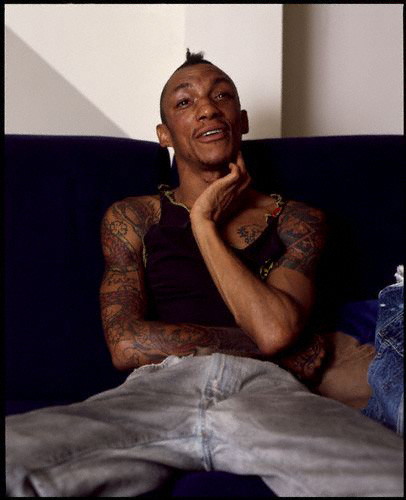
(Credit: Tricky (Adrian Thaws) © Sal Idriss / National Portrait Gallery, London)....Did you know that Tricky's a quarter Ghanaian via his late mother, Maxine Quaye?

There is a certain feel about the work of Kumasi born photographer, Sal Idriss that truly captivates, -I hope to work with him someday. Currently working in the music and film industry capturing images of black figures in mainstream culture like artist -Chris Ofili, architect -David Adjaye, the late great Malian photographer -Malick SidibĂ©, politician –Paul Boateng, fashion designer - Joe Casely-Hayford and actress - Sophie Okonedo (to name a few), he has also worked for publications like: the Guardian, The Times, the Mirror, GQ magazine, Mojo, Scotland on Sunday and ES magazine –and the likes of; fashion house -Commes Des Garcon, the National Portrait Gallery and City Hall.

Idriss has just completed a moving exhibition of his work entitled ‘Famous For The Wrong Reasons’ –a photographic exhibition aimed to educate and deter those vulnerable to gun and knife crime; inspired by the artist’s own experience and a tribute to his brother Nassirudeen, who died in 2007 as the result of an unprovoked knife attack in Islington, a few days before his 17th birthday. ** I’m so sorry that I didn’t find out about this exhibition sooner, –anyway it is over but you can still view some of the photographs from this exhibition at: http://www.richmix.org.uk/aandc_famousforthewrongreasons.htm

**For more information about this fabulous photographers work visit: http://www.sal-idriss.com/

Saturday, 20 March 2010

Fashion: Is Freema Agyeman the most fashionable Ghanaian woman in the world?

I just stumbled across this fabulous photo of Ghana Rising favorite, -Freema Agyeman and just had to share it. She looks soo hot in this silver dress……is she the most stylish Ghanaian woman in the world? www.freemaagyeman.com

Thursday, 9 April 2009

Books by Ghanaian Writers at: www.africanbookscollective.com


The above website is a treasure trove of books by African authors -and some of Ghana's most prolific writers can be found here. Work by the following authors are available: Albert Adu Boahen, Kofi Affrifah, Thomas N. Akabzaa, D.E.K. Amenumey, E. V. Asihene, Albert K. Awedoba, S.A. Brobbey, Woeli A. Dektsey, Florence Abena Dolphyne, J.O. de Graft Hanson , Pascal Hoba, Akua Kuenyehia, Takyiwaa Manuh, Sam Mensah, Samuel Obeng, Irene K. Odotei, Kwadwo Opoku-Agyemang, Alexandra Wilson, K.E. Yankson -Kongo Zabana and many more.
From: http://www.africanbookscollective.com/